
Expanded thoughts on Jeph Loeb and Jim Lee's Batman: H2SH... Part 1
Some thoughts on a project I find completely baffling. Yes, it's the sequel to 2005's "Hush"-- "H2SH"! Yes, the name is dumb. Yes, we'll get into that too.

Note: I started writing this around 14/04, and the story shifted around 24/04 with the announcement of Jim Lee’s health issues. I’ll get to that, because it changes nothing. On with the show—!
Hush why don’t you
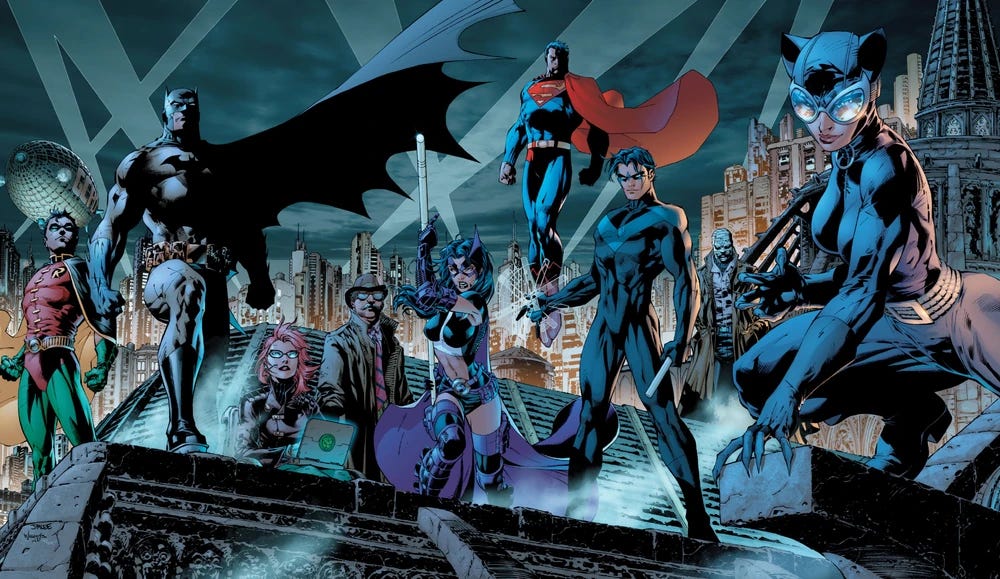
Oh, my God. I typed "Hush” so many times that I realised how dumb a word that is, and how perfectly underwhelming it as the nom de guerre of a supervillain. In a world of Jokers, Scarecrows and Killer Crocs, Hush (shush) just does not compete, does it?
After reading Peter Hensel‘s post about “H2SH”, I wrote a massive comment about how much I disliked… everything. It was long and rambling, as is my wont, so why not elaborate on the long-ness, and the rambling-ness, and re-share to my audience?
Here’s Peter’s original post, for those of you so inclined:

It’s a great read, and really got me thinking. As with my thoughts on most comics and comics-related content, if you get me thinking— and especially if you get me ranting— that’s a great sign. Anyway, on with the show!
All Opinions Are My Own, But Let Me Tell You Why They’re The Correct Opinions
I am so frustrated by the existence of “H2SH” (surely it should be “HU2H”?!). It’s a sloppy, self-indulgent, self-congratulatory victory lap on a story that was only successful not for the writing, but for the art. That’s Jeph Loeb’s MO. He’s not the best writer, but man does he get paired with some of the best artists.
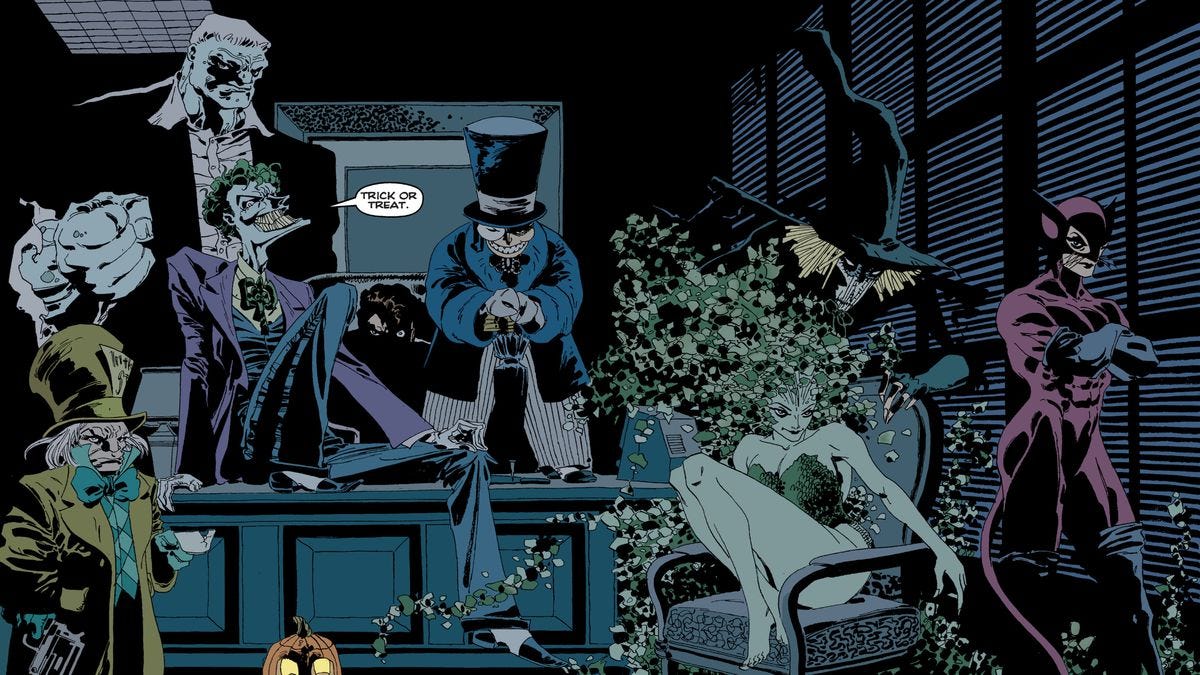
Even before ”Hush” (“H1SH”?), look at his collaborators. Tim Sale on Challengers of the Unknown (1991), Superman For All Seasons (1998), Batman: The Long Halloween (1996-1997), etc. Ed McGuinness was the majority artist during his run on Superman, (1999-2002) and later Superman / Batman (2003-2006).
After “Hush”, his collaborators were always the toppest of talent. Beyond McGuiness on Superman / Batman (2003-2006), he collaborated with the likes of Michael Turner, Carlos Pacheo and Pat Lee on the title… those are a list of legends, deserved or not1, right there.
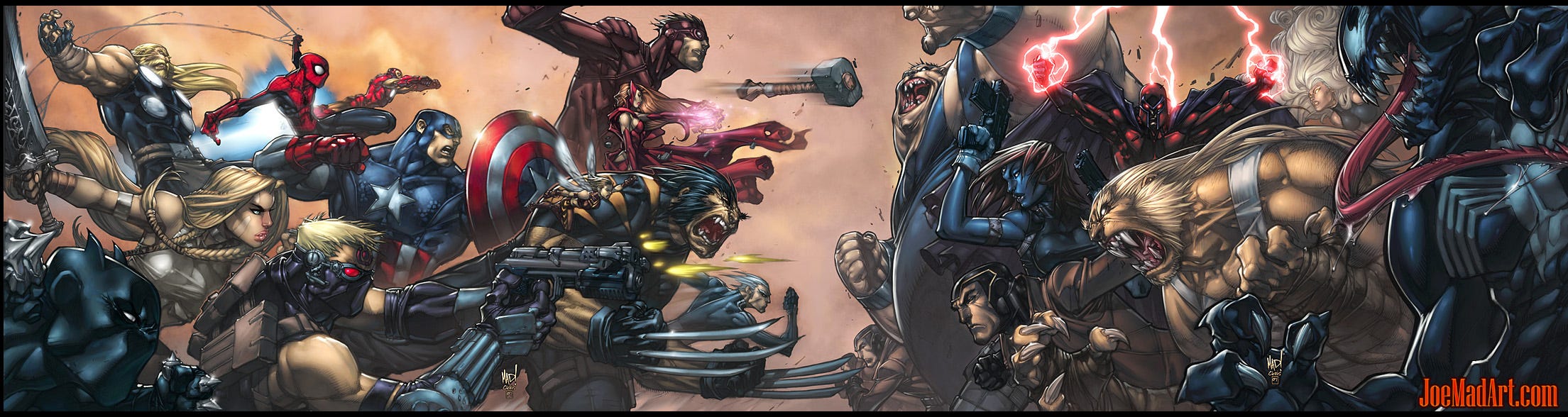
When he moved over to Marvel, he worked with Simone Bianchi on Wolverine #50-55 (2007), again with McGuinness again on Hulk (2008-2010), Joe Madureira on The Ultimates 3 (2008), David Finch on Ultimatum (2009), Frank Cho on Ultimate New Ultimates (2010), Art Adams on Ultimate X (2010-2011)… that’s a hall of fame, all with him writing schlocky, popcorn-y stories that let his collaborators show-off. He knows his place in the proceedings. “Write-this-big-thing-and-leave-the-rest-to-you.”
But don’t take these criticisms straight from me. Let’s pull up some receipts!
Fuck Jeph Loeb
From Josephine Riesman’s 26/05/15 Slate article, entitled “The Secret History of Ultimate Marvel, the Experiment That Changed Superheroes Forever”:
Loeb launched Ultimates 3 in 2007, and in the very first panel, the Ultimates are watching a sex tape of Iron Man and Black Widow. A few pages later, brother-and-sister heroes Quicksilver and Scarlet Witch are caught in an incestuous tryst—and just a few pages after that, Scarlet Witch is brutally murdered in broad daylight. That kind of random sex and violence was rampant throughout the third Ultimates outing, without the political relevance or epic pacing of the first two volumes. Sales were good, but reviews were terrible.
Regarding Ultimatum:
Over the course of just five issues, 34 different heroes and villains were murdered, often by gruesome means: Doctor Strange was squeezed until his head exploded; Magneto was decapitated; the Blob ate the Wasp and, while holding her half-devoured corpse, belched out, “Tastes like chicken”; and so on. It was an abattoir masquerading as a comics series, filled with anatomically improbable breasts and laughable dialogue. (I reached out to Loeb for an interview but was told he would only speak with me if we didn’t discuss Ultimates 3 or Ultimatum.)
Fans and retailers were furious. “It was fucking terrible,” […] adding that he was only able to sell about half of the copies he ordered for his store. [...] “Ultimatum #5 could quite possibly be the single worst piece of writing in recorded history,” wrote critic Jason Kerouac.
That’s Jeph Loeb. Those are his instincts. That’s his ability. Tell the most middle-of-the-road stories, while hitching your wagon to the best of the best. It’s a valuable skill because DC and Marvel give the man the assignments that allow him to flex them. Commercial to a tee. But his stories are all empty calories. Inessential.
Also, he’s a bit fucking racist. Let’s get into Jeph Loeb’s time running Marvel Television—because, yeah, there’s a bit to unpack.
During his tenure, Netflix’s corner of the Marvel universe— namely Daredevil, Iron Fist and The Defenders—started catching heat for how they handled East Asian characters and culture. The criticism wasn’t exactly subtle: people pointed to reductive stereotypes and a general lack of depth. And when the backlash hit Iron Fist over the decision to cast Finn Jones, Loeb’s defence boiled down to this: Danny Rand had to be a white outsider for the story to work.
Now, don’t get me wrong— I get it. In the comics, Danny Rand was a rich white kid whose parents died when their plane crashed into a mountain range, and he was taken in by a secretive, magic karate cult (now who’s being reductive…). In the comics, Danny is white. But being white isn’t essential to the character. The outsider perspective is. You know what is somewhat essential? That the character comes from privilege and loses everything and gains something through the tragedy. Danny Rand doesn’t need to be white. He doesn’t even need to be a man.
Then, at San Diego Comic-Con 2018, while promoting Iron Fist season two, Loeb walked on stage wearing a karate gi and headband as part of a joke with Jessica Henwick—who then made him take it off. What?? The whole thing didn’t exactly land, and was widely criticised as culturally insensitive. Not the kind of viral moment you want tied to a show already under scrutiny for that exact issue, eh?
And then 2020 rolls around, and things get more specific. During a Comic-Con@Home panel, actor Peter Shinkoda—who played Nobu in Daredevil—came out with some pretty blunt allegations. According to him, Loeb actively pushed writers to drop storylines that would’ve developed Asian characters like Nobu and Madame Gao. The reasoning? Shinkoda claims Loeb told the writers, “there were three previous Marvel movies, a trilogy called Blade that was made where Wesley Snipes killed 200 Asians each movie. Nobody gives a shit so don’t write about Nobu and Gao.”
Okay, conversely, Nobu and Gao weren’t the main characters of their respective shows; they were the villains. They didn’t need to have their own storylines, because… the shows aren’t called Nobu or Madame Gao. But if Loeb is coming out and reasoning that the real reason not to develop those characters is “who gives a shit?” then what the fuck. From what I remember of Madame Gao, she was brilliant in what we got, so if we had more, could we have had more cool moments and scenes with the character?
Also, Shinkoda also said he and Wai Ching Ho weren’t invited to the season two premiere and were paid less than extras. WHAT???
…I do not like Jeph Loeb.
And before anyone says, “well Jim Lee was born in Korea so Jeph Loeb can’t be racist”, I would counter that with Jim Lee makes Jeph Loeb so much fucking money and has done for decades, he probably doesn’t see any colour but green when it comes to their collaboration.
Why was Jim Lee drawing Batman?
When the Image Comics boys split from Marvel and formed their own studios in 1992, Wildstorm was Jim Lee’s. Along with his collaborators, he created countless properties, most of them riffs on Marvel properties. Reductively: WildC.A.T.s (Avengers), Gen13 (X-Men), Stormwatch (S.H.I.E.L.D.), Deathblow (Punisher)... Wildstorm also published Planetary and The Authority. For a year, Wildstorm handled the Heroes Reborn line of books alongside Rob Liefeld’s Extreme Studios, and then, and then, and then... DC bought Wildstorm in its entirety.
But why?
In Joseph Hedges’ essential “Wild Times: An Oral History of WildStorm Studios” (click to purchase), John Layman (former Wildstorm editor, current comics writer) is quoted as saying:
I never quite understood why they bought WildStorm other than to get our coloring department, which was the best at the time and to get Jim…
Jim Lee’s return to comics after DC purchased Wildstorm was a celebratory event, and it made perfect sense that he’d want to make a splash on an ongoing title like Batman. And you know what?“H1SH” moved units!
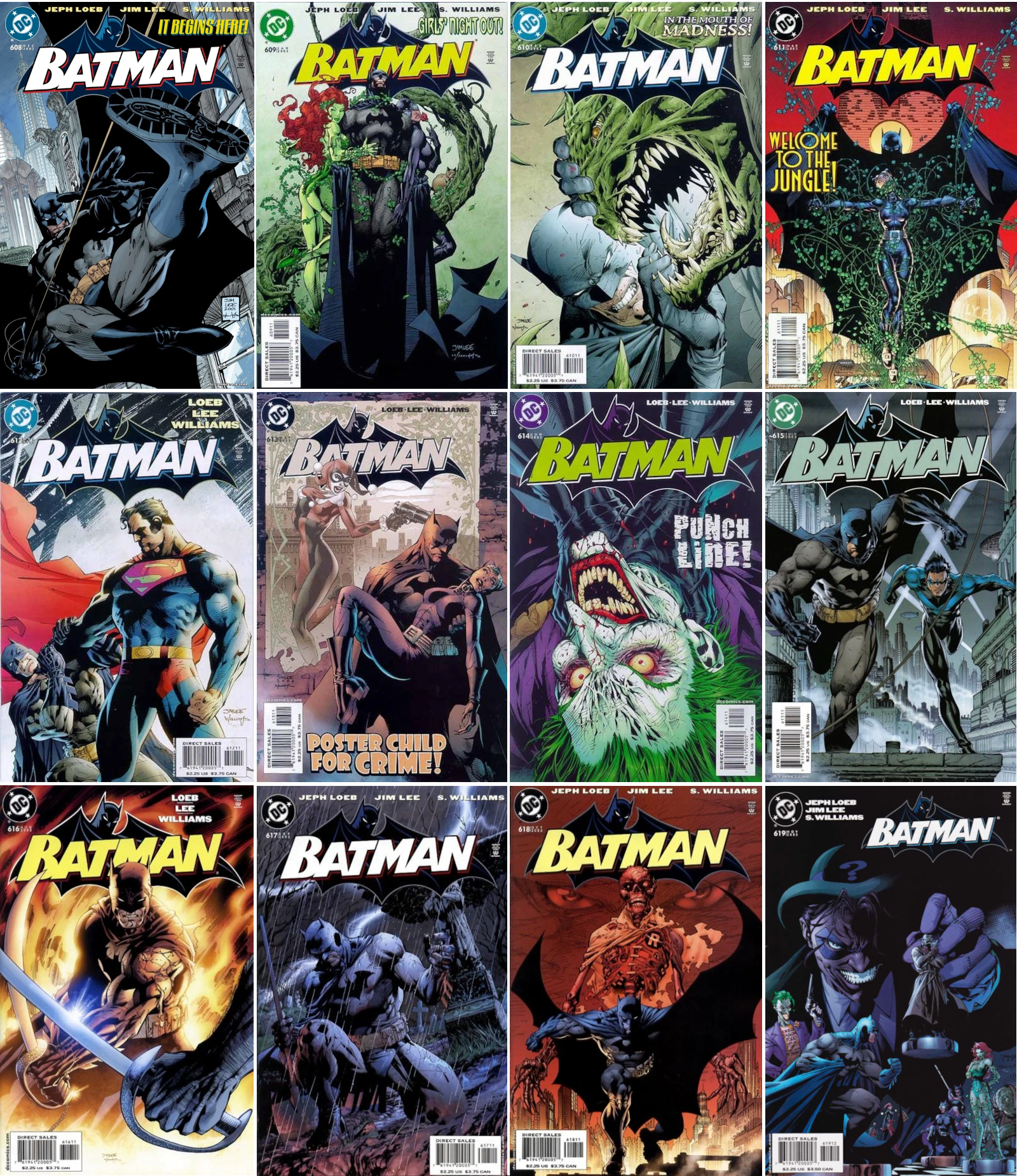
Estimated Distribution Figures for Batman 2002-2003
Gosh, this was fun to pull together. Here’s a look at the best estimated distribution figures, with thanks to John Jackson Miller’s Comichron:
Batman #599 - January 2002 - 50,673 units sold (#21 in the rankings, but the best seller of the month, Wolverine: The Origin #6, distributed 179,251)
⬆️+7,149 units from the previous issue
128,578 difference between Position #1 and #21
Part of the “Bruce Wayne: Murderer?” event.
Batman #600 - February 2002 - 57,113 units sold (#8 in the rankings, but the best seller of the month, Dark Knight Strikes Again #3, distributed 184,327)
⬆️+6,440 units from previous issue
127,214 difference between Position #1 and #8
Part of the “Bruce Wayne: Fugitive” storyline.
Batman #601 - March 2002 - 51,647 units sold (#17 in the rankings, but the best seller of the month, New X-Men #124, distributed 111,904)
⬇️-5,466 units from previous issue
60,257 difference between Position #1 and #17
Part of the “Bruce Wayne: Fugitive” storyline.
Batman #602 - April 2002 - 48,220 units sold (#24 in the rankings, but the best seller of the month, Transformers: Generation One #1, distributed 128,202)
⬇️-3,427 units from previous issue
79,982 difference between Position #1 and #24
Part of the “Bruce Wayne: Fugitive” storyline.
Batman #603 - May 2002 - 55,685 units sold (#18 in the rankings, but the best seller of the month, Transformers: Generation One #2, distributed 124,093)
⬆️+7,465 units from previous issue
68,408 difference between Position #1 and #18
Part of the “Bruce Wayne: Fugitive” storyline.
Batman #604 - June 2002 - 48,734 units sold (#26 in the rankings, but the best seller of the month, Transformers: Generation One #3, distributed 141,118)
⬇️-6,951 units from previous issue
92,384 difference between Position #1 and #26
Part of the “Bruce Wayne: Fugitive” storyline.
Batman #605 - July 2002 - 56,367 units sold (#21 in the rankings, but the best seller of the month, Transformers: Armada #1, distributed 145,567)
⬆️+7,633 units from previous issue
89,200 difference between Position #1 and #21
Epilogue for the “Bruce Wayne: Fugitive” storyline.
Batman #606 - August 2002 - 47,202 units sold (#30 in the rankings, but the best seller of the month, Transformers: Generation One #5, distributed 131,119)
⬇️-9,165 units from previous issue
83,917 difference between Position #1 and #30
Epilogue for the “Bruce Wayne: Fugitive” storyline.
Batman #607 - September 2002 - 46,527 units sold (#32 in the rankings, but the best seller of the month, Transformers: Generation One #6, distributed 127,550)
⬇️-675 units from previous issue
81,023 difference between Position #1 and #32
Epilogue for the “Bruce Wayne: Fugitive” storyline.
Ed Brubaker and Scott McDaniel’s run on the title ends.
Batman #608 - October 2002 - 120,945 units sold (#1 in the rankings)
⬆️+74,418 units from previous issue
“Hush” begins. Instant hit.
Batman #609 -November 2002 - 101,681 units sold (#6 in the rankings, but the best seller of the month, Masters of the Universe #1, distributed 112,276)
⬇️-19,264 units from previous issue
10,595 difference between Position #1 and #6
Batman #610 - December 2002 - 117,380 units sold (#3 in the rankings, but the best seller of the month, Ultimate War #1, distributed 131,829)
⬆️ +15,699 units from previous issue
14,449 difference between Position #1 and #3
Batman #611 - January 2003 - 129,377 units sold (#1 in the rankings)
⬆️+11,997 units from previous issue
Batman #612 - February 2003 - 145,400 units sold (#1 in the rankings)
⬆️+16,023 units from previous issue
Batman #613 - March 2003 - 133,628 units sold (#1 in the rankings)
⬇️-11,772 units from previous issue
Batman #614 - April 2003 - 153,556 units sold (#1 in the rankings)
⬆️+19,928 units from previous issue
Batman #615 - May 2003 - 143,139 units sold (#2 in the rankings, but the best seller of the month, Wolverine #1, distributed 157,739)
⬇️ -10,417 units from previous issue
14,600 difference between Position #1 and #2
Batman #616 - June 2003 - 141,988 units sold (#1 in the rankings)
⬇️-1,151 units from previous issue
Batman #617 - July 2003 - 145,998 units sold (#1 in the rankings)
⬆️4,010 units from previous issue
This issue features the [in]famous reveal that Jason Todd survived his murder at the hands of the Joker back in Batman #427 (1988). It was always supposed to be Clayface posing as Jason though, but Judd Winick later re-retconned it to being Jason in Batman Annual #25 (2006). I love comics.
Batman #618 - August 2003 - 149,040 units sold (#2 in the rankings, but the best seller of the month, Marvel 1602 #1, distributed 152,528)
⬆️+3,042 units from previous issue
3,488 difference between Position #1 and #2
Features the death of Harold :(
Batman #619 - September 2003 - 235,122 units sold (#1 in the rankings)
⬆️+86,082 units from the previous issue
Conclusion.
Batman #620 - October 2003 - 107,646 units sold (#7 in the rankings, but the best seller of the month, Avengers/JLA #2, distributed 162,309)
⬇️-127,476 units from previous issue
54,663 difference between Position #1 and #2
“Broken City” begins.
Getting Brian Azzarello and Eduardo Risso, then (and probably now) best known for their work on 100 Bullets (1999-2009), should have been a coup, but there was no way they could maintain the momentum of Loeb and Lee. I like the fact Patricia Mulvihill and Clem Robins came along too, a full transplant from Vertigo to DC for this arc. Imagine if we could swap a creative team from Marvel with one from DC for six issues… that’s something I could really get behind.
Batman #621 - November 2003 - 96,616 units sold (#7 in the rankings, but the best seller of the month, JLA/Avengers #3, distributed 147,938)
⬇️-11,030 units from previous issue
51,322 difference between Position #1 and #7
Batman #622 - December 2003 - 91,876 units sold (#11 in the rankings, but the best seller of the month, Ultimate Fantastic Four #1, distributed 173,397)
⬇️-4,740 units from previous issue
81,521 units difference between Position #1 and #11
I think the ups and downs of the units sold in the middle of the arc are really interesting. The story ramps up in the second half, and the sales seem to dip, but rally for the conclusion. Did interest begin to flatten? I wonder.
Regardless, “Hush” secured both men’s comics legacies, for better or worse. And now we have a sequel. Next time, we’ll talk about why it’s absolute garbage.
To Be Continued…
Pat Lee is a hack.
Unconvinced that Loeb is racist but agree that "Ultimatum" had to be an attempt to write the worst comicbook ever, and it's definitely a toss-up between that and Bill Jemas's "Marville." (I recall I liked the movie "Commando," which I was surprised to learn Loeb wrote, but I haven't seen it since I was a teen, so I don't know if it holds up.)
I had no idea there was a Hush 2 coming out. I probably won't read it because I don't want to support an industry that acts the way it has in the past 7-10 years. I'm sure there is plenty of great content out there though... I guess.
I do remember enjoying Hush when it was released, but enjoyed The Long Halloween more as I read the GN several times over the years, whereas I don't think I've ever reread Hush.
There was a Elseworlds Batman GN released in the early 90s called Red Rain or something like that, and it was fantastic.
I don't read superhero outside of event Batman GNs so I'm not the best at comparing them to what is released monthly.